
Modern SAP applications often need to execute time-consuming operations such as external service calls, heavy calculations, or mass data creation. Running such logic sequentially can slow down user interaction and block dialog processes. ABAP Cloud offers a clean and powerful way to distribute workload using parallel processing via the class CL_ABAP_PARALLEL.
In this blog, we will see:
-
What a parallel class is in ABAP Cloud
-
How to implement IF_ABAP_PARALLEL
-
How to execute RAP EML inside a parallel task
-
How to commit inside the task and return results
-
How this pattern can be reused in RAP actions, saver classes, or even BAPI scenarios
What is a Parallel Class?
A parallel class is a normal ABAP class that implements the interface IF_ABAP_PARALLEL.
This interface provides the method:
IF_ABAP_PARALLEL~DOwhich represents the logic that will run in a separate work process. Each instance of this class becomes an independent task executed by the framework.
The advantages are:
-
Multiple tasks run concurrently
-
Main session is not blocked
-
Each task has its own transactional context
-
You can perform COMMIT inside the task
Business Scenario
We have a managed RAP application:
-
Billing Document Header
-
Billing Document Item
-
Task BO (separate RAP Business Object with managed implementation)
Requirement:
-
Read a billing document item
-
Get its Material ID
-
Create a Task using RAP EML based on that Material
-
Commit inside the parallel task
-
Return the created Task UUID generated from managed Task app
-
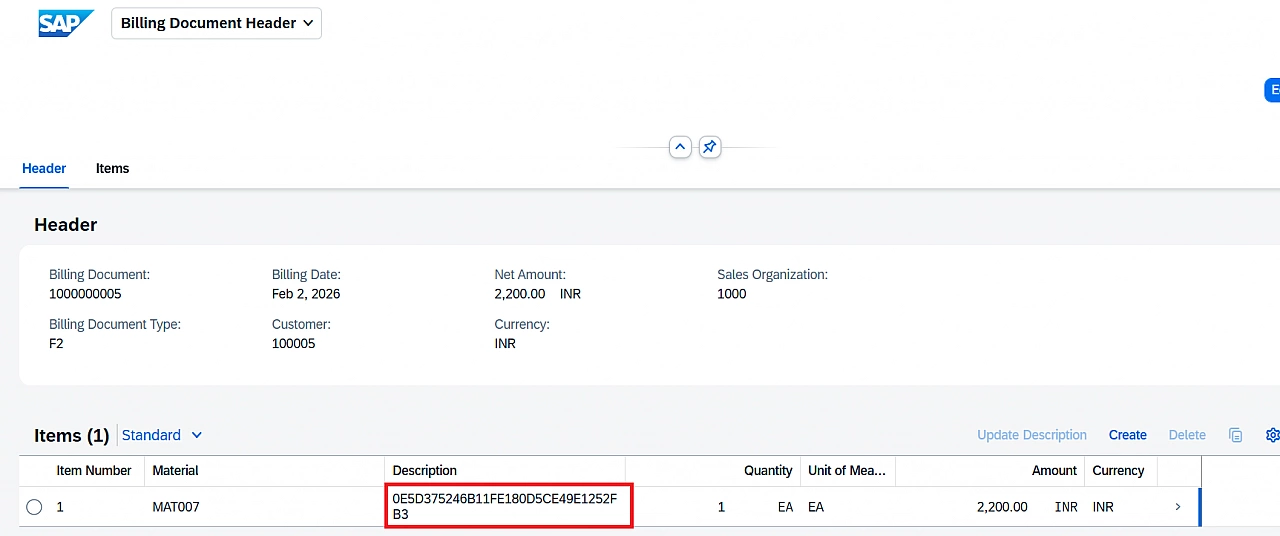
Update the billing item description with this UUID
All this should happen using parallel execution.
Step 1 – Create the Parallel Task Class
This class:
-
Receives Material ID in constructor
-
Implements IF_ABAP_PARALLEL
-
Creates Task using EML
-
Performs COMMIT ENTITIES inside the task
-
Returns the created UUID
Parallel Class Implementation
CLASS zsac_cl_parallel_task DEFINITION
  PUBLIC
  FINAL
  CREATE PUBLIC .

  PUBLIC SECTION.

    INTERFACES if_serializable_object .
    INTERFACES if_abap_parallel .

    METHODS: constructor IMPORTING iv_material TYPE string.

    METHODS get_result
      RETURNING VALUE(rt_result) TYPE string.

  PRIVATE SECTION.
    DATA: mv_material TYPE string.
    DATA mv_result  TYPE string.
ENDCLASS.
CLASS zsac_cl_parallel_task IMPLEMENTATION.

  METHOD constructor.
    mv_material = iv_material.
  ENDMETHOD.

  METHOD get_result.
    RETURN mv_result.
  ENDMETHOD.

  METHOD if_abap_parallel~do.

    DATA: lt_task_create TYPE TABLE FOR CREATE zsac_r_task_head\\ZsacRTaskHead,
          ls_task_create LIKE LINE OF lt_task_create,
          lt_reported    TYPE RESPONSE FOR REPORTED EARLY zsac_r_task_head,
          lt_mapped      TYPE RESPONSE FOR MAPPED EARLY zsac_r_task_head,
          lt_failed      TYPE RESPONSE FOR FAILED EARLY zsac_r_task_head.

    lt_task_create = VALUE #( (
        %cid           = 'MY_CID_1'
        TaskID         = | TASK- | && mv_material
        Title          = | New task for | && mv_material
        Description    = 'Test Description'
        OverallStatus  = 'O'
        %control       = VALUE #(
                           TaskID        = if_abap_behv=>mk-on
                           Title         = if_abap_behv=>mk-on
                           Description   = if_abap_behv=>mk-on
                           OverallStatus = if_abap_behv=>mk-on
                         )
    ) ).

    MODIFY ENTITIES OF zsac_r_task_head
      ENTITY ZsacRTaskHead
        CREATE FROM lt_task_create
      MAPPED   lt_mapped
      FAILED   lt_failed
      REPORTED lt_reported.

    IF lt_failed IS INITIAL.
      COMMIT ENTITIES.
      mv_result = lt_mapped-zsacrtaskhead[ 1 ]-taskuuid.
    ENDIF.

  ENDMETHOD.
ENDCLASS.
Key Points
-
EML is executed inside the parallel session
-
COMMIT ENTITIES is allowed here
-
Result is stored in instance attribute
-
get_result method exposes the value
Step 2 – Calling the Parallel Class
To keep the example simple, we call it from a local class implementing IF_OO_ADT_CLASSRUN.
Execution Flow
-
Read billing item using EML
-
Extract Material ID
-
Create instance of parallel task
-
Run using CL_ABAP_PARALLEL
-
Collect result
-
Update billing item description
CLASS zsac_cl_process IMPLEMENTATION.

  METHOD if_oo_adt_classrun~main.

    DATA: lt_processes TYPE cl_abap_parallel=>t_in_inst_tab.

    READ ENTITIES OF zsac_r_bill_headtp
        ENTITY zsac_r_bill_itemtp FIELDS ( MaterialId )
          WITH VALUE #( ( BillID = '1000000005' ItemNo = '000001' ) )
           RESULT DATA(lt_bill_items).

    DATA(lv_material) = lt_bill_items[ 1 ]-MaterialId.

    INSERT NEW zsac_cl_parallel_task( CONV #( lv_material ) )
      INTO TABLE lt_processes.

    NEW cl_abap_parallel( p_num_tasks = 3 )->run_inst(
        EXPORTING p_in_tab  = lt_processes
        IMPORTING p_out_tab = DATA(lt_finished)
    ).

    DATA(ls_finished) = lt_finished[ 1 ].
    DATA(lv_desc) = CAST zsac_cl_parallel_task(
                       ls_finished-inst )->get_result( ).

    MODIFY ENTITIES OF zsac_r_bill_headtp
      ENTITY zsac_r_bill_itemtp
      UPDATE FROM VALUE #(
        ( BillId               = '1000000005'
          ItemNo               = '000001'
          description          = lv_desc
          %control-description = if_abap_behv=>mk-on ) ).

    COMMIT ENTITIES.

  ENDMETHOD.
ENDCLASS.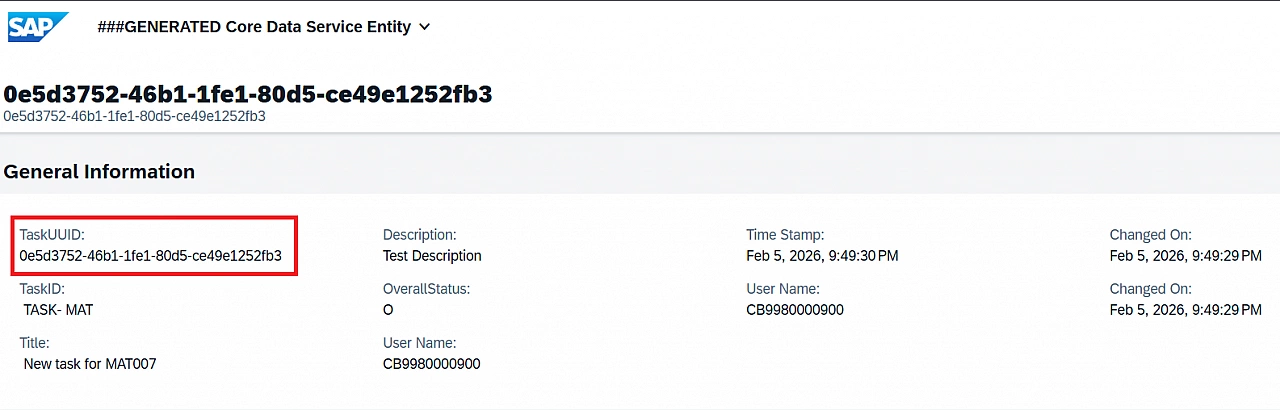
Why This Pattern is Powerful
1. RAP Framework Restrictions
Inside RAP:
-
COMMIT WORK and COMMIT ENTITIES statements are forbidden
-
Long running logic blocks UI
With parallel class:
-
You get a separate LUW
-
You can commit safely
-
RAP transactional buffer remains clean
2. Where Can We Use This?
This concept is extremely useful in:
-
RAP action implementations
-
Saver class methods
-
Determinations with heavy logic
-
Mass creation scenarios
-
External API or BAPI calls
For example:
-
Call legacy BAPI in parallel class
-
Perform COMMIT WORK there
-
Return updated keys
-
Continue RAP flow without dumps
3. Clean Architecture
-
Business logic isolated
-
No RAP lifecycle conflict
-
Scalable execution
-
Better performance
Conclusion
Parallel processing in ABAP Cloud is not only for classic reports.
It fits perfectly into RAP architecture when:
-
You need independent transactions
-
External commits are required
-
Heavy processing must be offloaded
You can refer to this link for SAP's documentation on parallel processing.